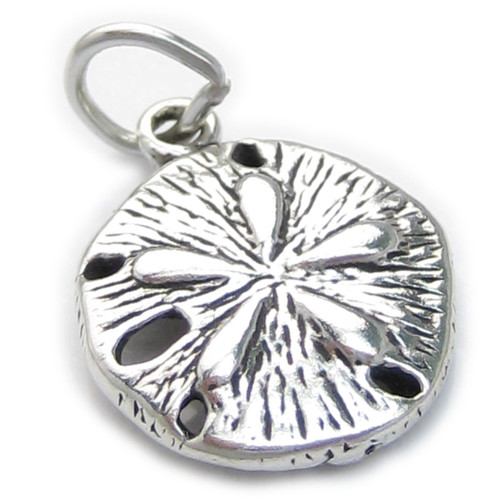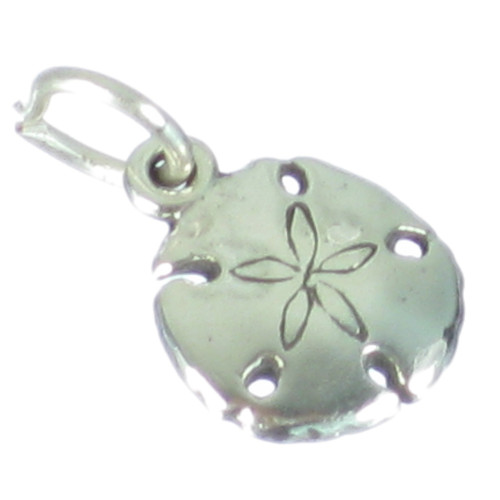


This is a lovely sterling silver charm of a Sand Dollar or what some may recognise as a sea cookie charm or a sand cake charm or sea biscuit charm!
Sand dollars are flat, burrowing echinoderms in the order Clypeasteroida, making them close relatives of sea urchins, sea stars, and sea cucumbers. While the white, star-patterned "shells" found on beaches are actually the bleached exoskeletons (tests) of deceased animals, living sand dollars are covered in velvety, moving spines that appear in colors like purple, brown, gray, or green.
Habitat and Behavior: They inhabit sandy or muddy seafloors from the intertidal zone to depths of roughly 130 feet (40 meters) in temperate and tropical waters worldwide. To survive, they burrow into the sand; in calm waters, they stand upright, while in rough conditions, they lie flat or ingest sand to weigh themselves down. They often live in dense groups, with up to 625 individuals per square yard.
Anatomy and Diet: Their mouth, located on the underside, features a jaw structure known as "Aristotle’s lantern" with five teeth-like sections for grinding food. They are filter feeders that use tiny hairs (cilia) on their spines to capture plankton, algae, and detritus, a process that can take up to two days to digest. Scientists can determine their age by counting growth rings on their skeletons, as they typically live for 6 to 10 years.
Sand dollars are primarily called sand dollars because their sun-bleached, white, circular skeletons (tests) resemble the Spanish dollar (or "piece of eight"), a large silver coin from the colonial era.
Other common alternative names and their origins include:
Sea cookie (or snapper biscuit in New Zealand): Refers to the flat, disc-like shape of the organism.
Sand cake (or cake urchin): Describes the flat, biscuit-like appearance before the monetary comparison became common.
Pansy shell: Used in South Africa because the five-pointed star pattern on the dorsal side resembles a five-petaled flower.
Sea biscuit (or galleta de mar in Spanish-speaking regions): Highlights the round, flat form similar to a hardtack biscuit.
These names emerged from beachcombers' observations of the flat, burrowing sea urchins (order Clypeasteroida) washed ashore, where the bleached skeleton lacked its natural purple or brown "velvet" skin, leaving a stark white disc.
- BulletPoint1:
- Sand Dollar
- BulletPoint2:
- Sterling Silver .925
- BulletPoint3:
- Charm
- BulletPoint4:
- Fitting - Jump Ring - NOT suitable for bead bracelets - NOT suitable for Pandora bracelets - to fit a Pandora bracelet or another design please send a message before purchasing so we can advise the additional fitting that you need to buy
- Metal:
- Sterling Silver
- Style:
- Charm
- Metal Purity:
- 925
- Theme:
- Animals & Insects
- Type:
- Charm
- Fastening:
- Fitting - Jump Ring
- Manufacturer:
- Maldon Jewellery
- Charm Type:
- Traditional
- Base Metal:
- Sterling Silver
- ModelPart:
- 86908REDF
- REF:
- REF MC
- Main Stone:
- No Stone
- Colour:
- Silver
- Metal Type:
- Sterling Silver
- Attachment Loop:
- Fitting - Jump Ring
- Department name:
- Women's
- Country of Origin:
- Great Britain
- BulletPoint5:
- Sea cookie - Snapper Biscuit - Sand cake - Pansy Shell - Sea Biscuit
- Brand name:
- Maldon Jewellery