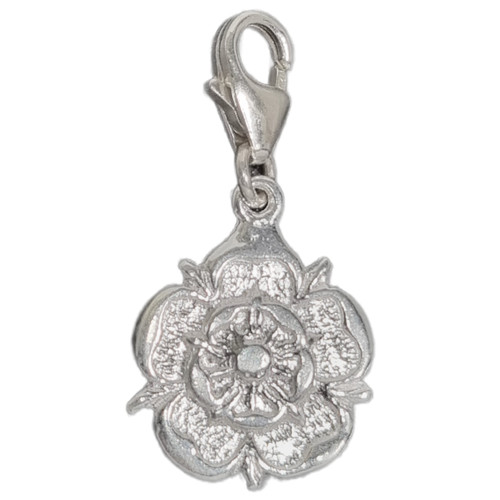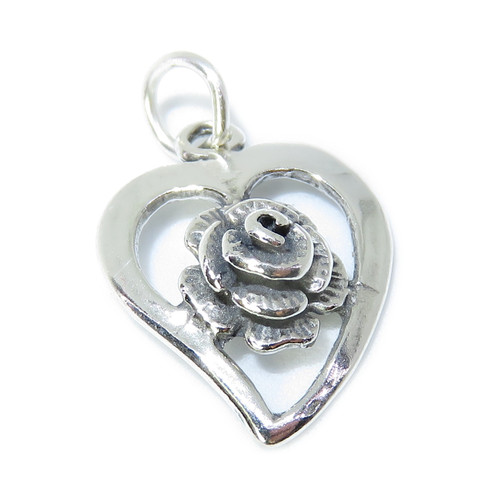


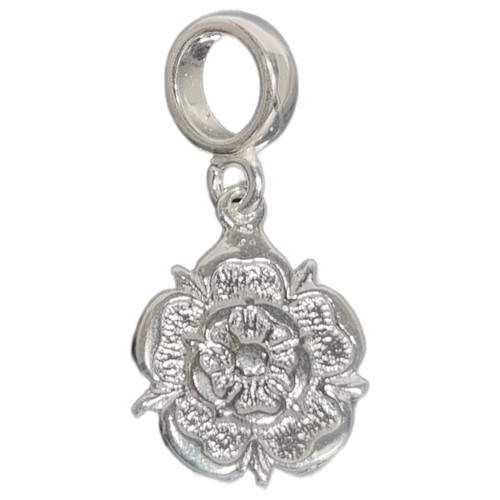
This is a beautiful Rose of Lancaster charm on a bead fitting.
Bother the rose and the fitting are sterling silver.
The Red Rose of Lancaster: A Legacy of Royalty, Conflict, and Heritage
The Red Rose of Lancaster stands as one of the most resonant and visually striking heraldic emblems in British history. More than just a botanical specimen, it is a symbol steeped in medieval pageantry, fierce dynastic warfare, and the enduring identity of northern England. Whether carved into stone, embroidered on regimental banners, or invoked as a badge of regional pride, the red rose carries a narrative that shaped the course of the English monarchy.
Medieval Origins and Royal Lineage
The story of the red rose begins long before the conflicts that made it famous. In the 13th and 14th centuries, it was adopted as a heraldic badge by the House of Lancaster, a powerful cadet branch of the royal Plantagenet dynasty. Edmund Crouchback, the first Earl of Lancaster and son of King Henry III, is often credited with establishing the lineage's early connections to French territories where distinct roses flourished. Over generations, the emblem became shorthand for Lancastrian power, influence, and territorial reach across the north of England.
The Wars of the Roses
The emblem's most dramatic chapter arrived with the Wars of the Roses (1455–1487), a turbulent series of civil wars fought for control of the English throne. The conflict pitted two rival branches of the royal family against one another: the House of Lancaster, symbolized by the Red Rose, and the House of York, symbolized by the White Rose.
While 15th-century combatants relied on a wide array of household badges and banners rather than marching exclusively under single flowers, later chroniclers and William Shakespeare immortalized the conflict as a poetic botanical war. The imagery of clashing red and white petals came to define a generation of power struggles between cousins, reshaping the English nobility.
Birth of the Tudor Rose
The civil strife ultimately drew to a close in 1485 at the Battle of Bosworth Field, where Henry Tudor of the House of Lancaster defeated King Richard III of the House of York. To heal the deep divisions of the country and legitimize his new reign, Henry VII married Elizabeth of York.
This union of former adversaries gave birth to the Tudor Rose, a brilliant heraldic fusion that layered the White Rose of York inside the Red Rose of Lancaster. This powerful peace symbol graced architecture, coinage, and royal seals across the realm, signalling an end to decades of bloodshed and the dawn of the Tudor dynasty.
The Botanical Counterpart: Rosa gallica
Culturally and historically, the Red Rose of Lancaster is closely identified with Rosa gallica officinalis, commonly known as the Apothecary's Rose or the Red Rose of Provins. Believed to be one of the oldest cultivated roses in history, it features deep crimson petals, golden stamens, and a rich, unmistakable fragrance. Long valued in antiquity and medieval Europe for its medicinal properties and perfumes, the hardy shrub mirrors the resilience and striking visual depth of its heraldic namesake.
Modern Identity and Global Legacy
Today, the Red Rose of Lancaster remains a vibrant symbol of regional identity for the historic county of Lancashire and its people. It features prominently on civic coats of arms, sports team emblems, and military insignia, including the Duke of Lancaster’s Regiment. Furthermore, its influence stretches far beyond British shores; cities like Lancaster, Pennsylvania, proudly wear the mantle of the "Red Rose City," ensuring that this centuries-old medieval badge continues to flourish across the globe.
- BulletPoint1:
- Rose of Lancaster
- BulletPoint2:
- Sterling Silver .925
- BulletPoint3:
- Charm
- BulletPoint4:
- Fitting - Bead Carrier - WITH soldered connecting ring compatible with MOST Pandora Moments
- BulletPoint5:
- Roses of Lancaster
- Attachment Loop:
- Bead Carrier
- Base Metal:
- Sterling Silver
- Brand name:
- Maldon Jewellery
- Charm Type:
- Bead
- Colour:
- Silver
- Country of Origin:
- Great Britain
- Department name:
- Women's
- Fastening:
- Bead Carrier
- IT_stile:
- Moderno
- Main Stone:
- No Stone
- Manufacturer:
- Maldon Jewellery
- Metal:
- Sterling Silver
- Metal Purity:
- 925
- Metal Type:
- Sterling Silver
- ModelPart:
- C0M91CVCM4
- REF:
- REF MC
- Style:
- Charm
- Theme:
- Travel & Places
- Type:
- Charm